Modern minimalist chandeliers represent a distinct category within contemporary lighting design. They emphasize simplicity, functionality, and uncluttered aesthetics, aligning with the broader principles of minimalism as an artistic and architectural movement. This article explores the defining characteristics, historical context, design principles, and practical considerations of these fixtures.
Modern minimalist chandeliers Ezerliving are distinguishable by several core features that set them apart from more opulent or traditional lighting fixtures. These characteristics are not merely aesthetic choices but reflect an underlying philosophy of design.
Form Follows Function
The adage “form follows function” is central to modern minimalist chandelier design. Each component of the chandelier, from individual light sources to structural elements, serves a deliberate purpose. Ornamentation for its own sake is typically avoided. This often results in clean lines, geometric shapes, and an absence of superfluous embellishments. For instance, a linear arrangement of LED modules might define the fixture’s shape, simultaneously providing illumination and contributing to its architectural form. The design prioritizes effective light dispersion and structural integrity over decorative complexity.
Materiality and Finish
The selection of materials in minimalist chandeliers is crucial. Designers often opt for materials that convey a sense of understated elegance and modernity.
Common Materials
- Metals: Brushed or polished metals such as aluminum, steel, and brass are frequently used. These materials offer durability, allow for precise fabrication, and possess inherent reflective qualities that can enhance light distribution. Finishes often include matte black, white, brushed nickel, or polished chrome.
- Glass: Frosted, clear, or opal glass is employed for diffusers, softening the light and preventing glare. Glass elements are typically simple geometric forms, like spheres, cylinders, or flat panels.
- Acrylic/Polycarbonate: These synthetic materials offer lightweight alternatives to glass, providing similar light diffusing properties and allowing for more complex, yet still minimalist, shapes.
- Wood: While less common than metals, certain minimalist designs incorporate natural wood elements, often light-toned or stained dark, to introduce warmth and organic texture without detracting from the overall simplicity.
Finish Considerations
Finishes are generally muted and non-reflective, emphasizing the material’s integrity rather than an ornate surface. Matte finishes minimize visual clutter and absorb light, contributing to a calm, sophisticated aesthetic. High-gloss finishes are used selectively to create points of visual interest or to enhance reflectivity in specific design concepts.
Light Source and Technology Integration
Modern minimalist chandeliers heavily leverage advancements in lighting technology, particularly LED (Light Emitting Diode) technology.
LED Integration
LEDs enable compact and energy-efficient designs. Their small size and low heat output allow for lighting elements to be integrated seamlessly into the fixture’s structure, rather than being housed in bulky traditional bulbs. This contributes to the sleek profiles characteristic of minimalist design.
- Integrated LEDs: Many minimalist chandeliers feature integrated LED arrays that are not user-replaceable, contributing to a streamlined appearance.
- Dimmability: Most minimalist chandeliers are designed to be dimmable, offering users control over ambient light levels and mood. This functionality is often seen as a practical extension of the minimalist ethos, providing versatility without added visual complexity.
- Color Temperature Control: Some advanced fixtures offer tunable white light, allowing the user to adjust the color temperature from warm to cool, adapting the lighting to different times of day or activities.
Historical Context and Evolution
The minimalist aesthetic in lighting did not emerge in a vacuum. It is deeply rooted in broader art and design movements of the 20th century. Understanding this lineage helps to contextualize current trends.
Roots in Modernism
Minimalism can largely be seen as an offshoot and refinement of modernism, particularly post-World War II. Modernist principals, championed by figures like Le Corbusier, Ludwig Mies van der Rohe, and Walter Gropius, advocated for stark functionality, industrial materials, and a rejection of historical ornamentation. These ideas filtered into lighting design, moving away from heavy, decorated chandeliers towards simpler, more utilitarian forms.
Bauhaus Influence
The Bauhaus school in Germany, active from 1919 to 1933, was pivotal in establishing foundational modernist principles. It promoted the idea that good design should be accessible, functional, and aesthetically clean. While early Bauhaus lighting might appear rudimentary by today’s standards, its emphasis on geometric shapes, industrial materials, and mass production laid the groundwork for future minimalist expressions. Consider Wilhelm Wagenfeld’s table lamp (1924) – a simple sphere and cylinder – as an early precursor to minimalist ideals in design.
Mid-Century Modern Simplification
The mid-20th century saw a further simplification of forms. Designers experimented with new materials like plastics and bent plywood, creating furniture and lighting that were both innovative and less ornate. Chandeliers from this era, exemplified by designers like George Nelson or Serge Mouille, began to shed the excesses of previous eras, focusing on sculptural forms and directed light. These pieces, while perhaps not strictly “minimalist” in the contemporary sense, paved the way for current designs by prioritizing clean lines and functional elegance.
Contemporary Minimalism
The late 20th and early 21st centuries saw a resurgence and refinement of minimalist principles, partly in response to the perceived clutter and excesses of consumer culture. This manifested in architecture, interior design, and product design, including lighting. Contemporary minimalist chandeliers consolidate these historical lessons, blending technological advancements with a distilled aesthetic. They often incorporate smart home integration and sustainable practices, aligning with modern values that extend beyond mere appearance.
Design Principles and Aesthetic Impact
The design principles governing modern minimalist chandeliers are not superficial; they aim to create specific aesthetic and psychological effects within an environment.
Negative Space and Visual Weight
One of the most powerful tools in minimalist design is the strategic use of negative space. Rather than filling every available area with material, designers intentionally leave voids within the fixture’s structure or between its components. This creates a sense of lightness and openness.
Psychological Impact
- Reduced Visual Clutter: A minimalist chandelier acts as a visual anchor without dominating the space. Its simplicity helps to keep the overall environment uncluttered, promoting a sense of calm and order.
- Enhanced Spatial Perception: By not overwhelming the eye, these fixtures allow the observer to appreciate the broader architectural features of a room. They become an integral part of the space rather than a standalone decorative object. The fixture itself becomes a visual whisper rather than a shout, drawing attention to its form and the light it casts, not merely its decorative elements.
Geometric Forms and Lines
Minimalist chandeliers predominantly feature clean, geometric forms. Circles, squares, rectangles, and straight lines are recurring motifs.
Expressive Geometry
- Clarity and Precision: These forms convey precision and intentionality. There is little room for ambiguity in their design. A series of interconnected lines, for instance, might describe a complex structure that appears simple from a distance, revealing its intricate yet disciplined geometry upon closer inspection.
- Balance and Harmony: The arrangement of these geometric elements is often balanced, either symmetrically or asymmetrically, to create visual harmony. This balance contributes to the fixture’s ability to seamlessly integrate into various contemporary interior styles.
Integration with Architecture
A hallmark of good minimalist design is its ability to integrate with the surrounding architecture rather than merely decorating it. A minimalist chandelier should feel like an extension of the space itself.
Seamless Blending
- Subtle Accent: These fixtures are often designed to complement the structural lines and material palette of a room. For example, a linear chandelier might mirror the architectural beams of a ceiling, or its finish might echo the metal accents used elsewhere in the interior.
- Lighting as Architecture: In some cases, the lighting fixture itself becomes an architectural element, defining zones or pathways within a larger open-plan space. It guides the eye and subtly influences movement, acting as a functional sculpture.
Practical Considerations for Selection and Placement
Choosing and installing a modern minimalist chandelier involves more than just aesthetic preference. Practical factors are paramount to ensuring its effectiveness and appropriateness for a given space.
Sizing and Scale
The size and scale of a chandelier relative to the room it occupies are critical. An undersized fixture will appear insignificant, while an oversized one can overwhelm the space and violate the minimalist principle of understated presence.
Room Dimensions
- Diameter Rule: A common guideline for dining rooms, for example, is to choose a chandelier with a diameter roughly half to two-thirds the width of the dining table. For square rooms, a good starting point is to choose a fixture whose diameter in inches is roughly the sum of the room’s length and width in feet (e.g., a 10’x12′ room suggests a 22-inch diameter fixture).
- Ceiling Height: High ceilings can accommodate larger, longer fixtures that draw the eye upward and utilize the vertical space. For standard 8-9 foot ceilings, fixtures that are less obtrusive and do not hang too low are generally preferred to maintain an open feel.
Light Output and Distribution
Minimalist chandeliers, despite their understated appearance, must provide adequate illumination. Their design often dictates the nature of light distribution.
Illumination Needs
- Task vs. Ambient: Consider whether the chandelier is primarily for ambient lighting, providing general illumination, or if it needs to support specific tasks (e.g., over a dining table or kitchen island).
- Lumen Output: Pay attention to the fixture’s lumen output (a measure of total visible light). A large room or one requiring bright general illumination will need a higher lumen output.
- Diffused vs. Directed Light: Many minimalist designs employ diffusers (glass, acrylic) to create a soft, uniform ambient glow. Others might feature multiple individual light sources arranged to direct light more precisely, which is useful for accentuating particular areas or surfaces.
Installation and Maintenance
The simplicity of minimalist design extends to installation and ongoing maintenance in many cases, although specific designs can present unique challenges.
Installation Requirements
- Weight and Support: Ensure the ceiling junction box and joists can support the chandelier’s weight. Larger fixtures may require additional structural support.
- Electrical Wiring: Most installations require standard electrical wiring. Some advanced fixtures might integrate smart home technology, necessitating specific wiring or control systems.
- Adjustability: Many minimalist linear or geometric chandeliers offer adjustable suspension cables, allowing the installer to fine-tune the hanging height. This versatility is crucial for achieving optimal placement.
Maintenance Considerations
- Cleaning: The simple forms and smooth surfaces of minimalist chandeliers generally make them easier to clean than ornate fixtures. Dusting with a soft cloth or occasional wiping with a mild cleaner is usually sufficient.
- LED Lifetime: Integrated LED fixtures typically have very long lifespans (tens of thousands of hours), minimizing the need for bulb replacements. This contributes to the low-maintenance appeal. However, if an integrated LED module fails, the entire fixture or a significant component may need to be replaced, which can be a consideration.
Applications in Contemporary Interiors
Modern minimalist chandeliers are versatile and can enhance a variety of contemporary interior spaces, serving both functional and aesthetic purposes. Their ability to blend seamlessly while making a subtle statement makes them highly adaptable.
Residential Spaces
In homes, these fixtures often act as focal points without dominating the room.
Dining Rooms
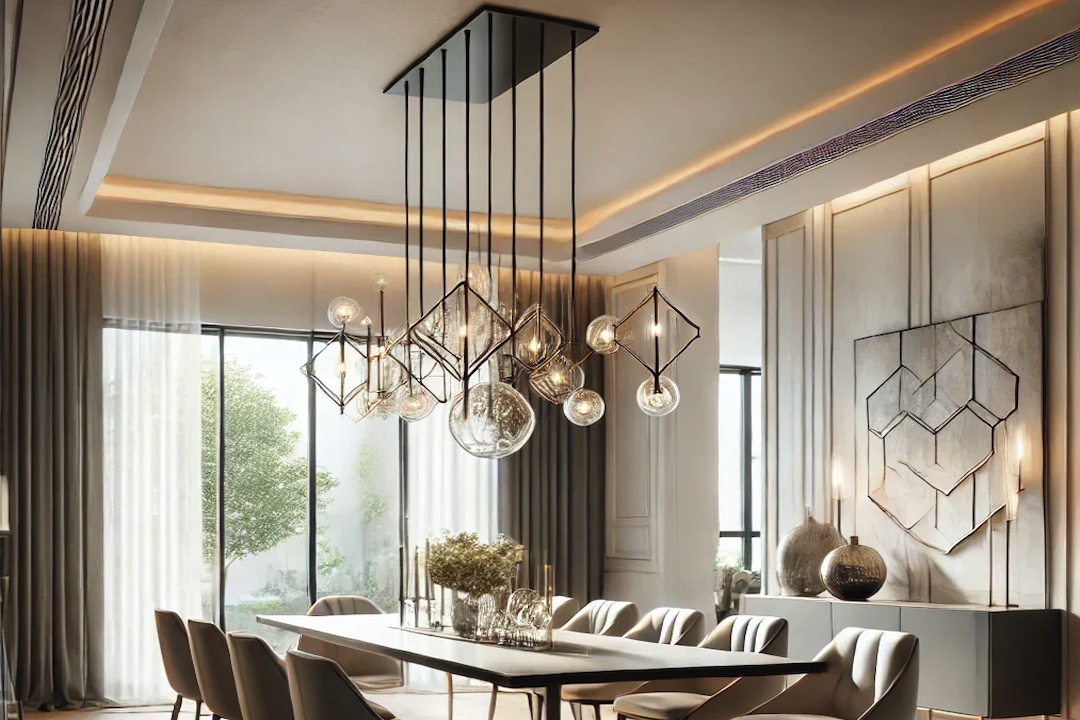
- Above Dining Tables: Linear minimalist chandeliers are particularly well-suited for dining tables, providing even illumination across the surface while complementing the table’s form. Pendants that are artfully arranged in a linear fashion can also achieve this effect. They offer a clean visual line that doesn’t obstruct views or conversation, a cornerstone of minimalist thinking.
Living Rooms
- Ambient Illumination: A large, geometric or linear minimalist chandelier can provide general ambient light in a living room, especially in open-plan spaces. Its understated design allows for other decorative elements to shine, or for the architecture itself to be the primary focus.
- Sculptural Element: Even without being the brightest light source, a well-placed minimalist chandelier can function as a piece of sculptural art, drawing the eye upwards and adding an element of sophistication.
Kitchens
- Island Lighting: Similar to dining tables, linear minimalist chandeliers or multiple minimalist pendants arranged in a row are ideal for illuminating kitchen islands. They provide focused task lighting for food preparation and can delineate the island area within a larger kitchen.
- Open Shelving Integration: These fixtures can complement the clean lines often found in modern kitchens with open shelving or integrated appliances, maintaining the overall sense of uncluttered efficiency.
Commercial and Hospitality Environments
Minimalist chandeliers also find widespread application in commercial settings where modern aesthetics and functionality are prioritized.
Offices
- Meeting Rooms: Linear or structured minimalist chandeliers are excellent for meeting rooms, providing uniform lighting that promotes focus. Their professional and understated appearance aligns with corporate design standards.
- Minimalist Workspace: In open-plan offices, multiple linear fixtures can be used to define different zones or direct light effectively without creating visual noise.
Restaurants and Hotels
- Lobby Areas: Large-scale minimalist chandeliers can make a statement in hotel lobbies without resorting to excessive ornamentation. They contribute to an atmosphere of refined elegance and modernity.
- Dining Areas: In restaurants, thoughtfully designed minimalist chandeliers can create an intimate atmosphere, or provide uniform ambient light, depending on the desired mood. Their clean lines often complement a contemporary dining experience.
In essence, the modern minimalist chandelier is more than just a light source; it is a design philosophy made tangible. It requires disciplined judgment from the designer and a discerning eye from the user. It offers a solution for those who believe that true elegance lies not in accumulation, but in carefully considered reduction. Its continued evolution promises fixtures that are not only aesthetically refined but also technologically advanced and environmentally conscious, mirroring the broader trajectory of contemporary design.